- Suitable as receiver optical amplifiers for long-reach optical transceivers
- Supports 100GBASE-ER4, 100GBASE-ZR, 400GBASE-LR4, 400GBASE-LR8, and coherent transceiver systems
- Provides high optical gain for weak-signal detection
- Low noise figure enabling improved receiver sensitivity
- Compact, low-power semiconductor design
- High reliability and telecom-grade stability
- Compatible with DWDM and high-speed optical communication systems



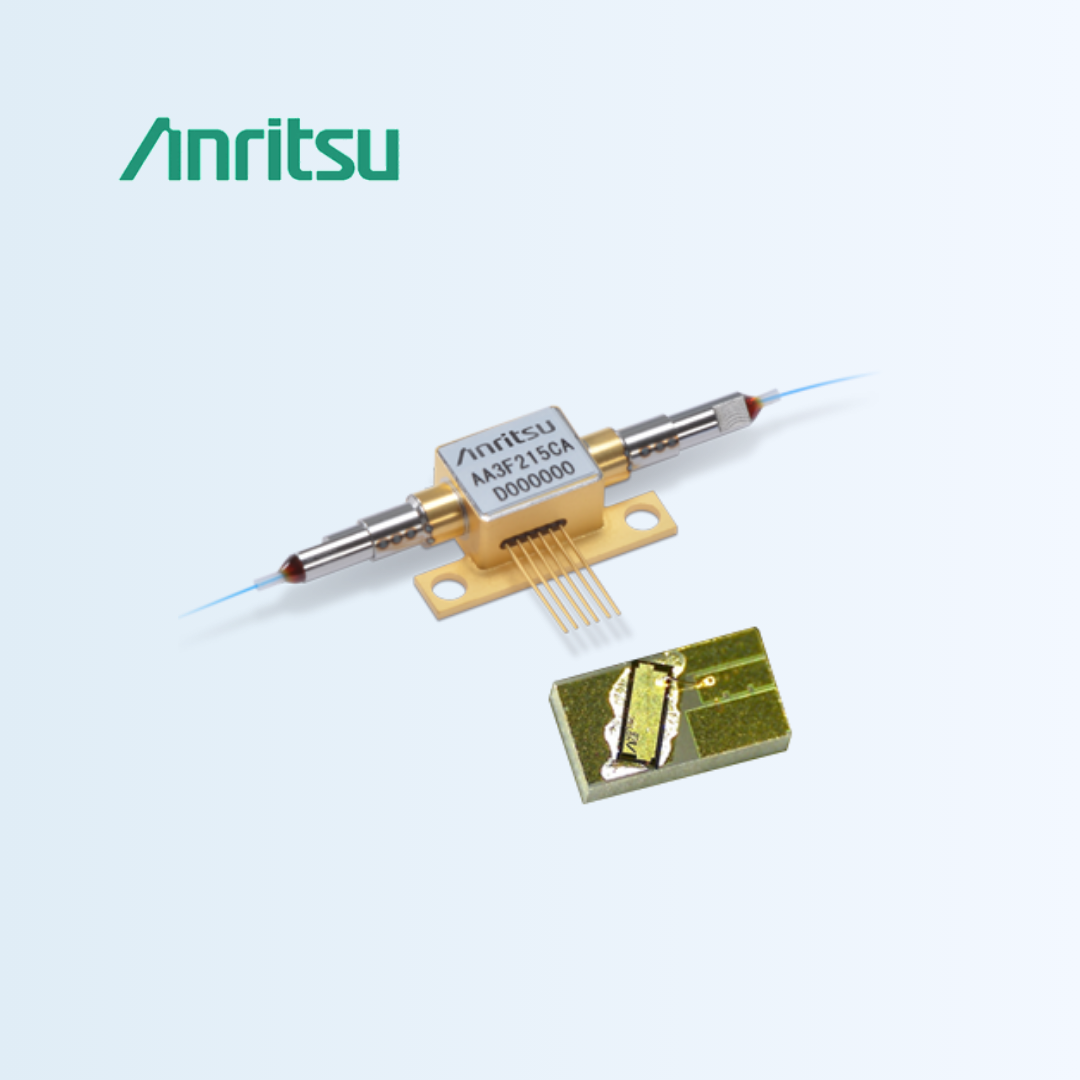
SOA (Semiconductor Optical Amplifier)
Optical Devices for Communication
An SOA (Semiconductor Optical Amplifier) is a semiconductor element that amplifies light. Antireflective processing is applied on both facets of a semiconductor laser to eliminate the resonator structure. When light enters from outside the semiconductor, the light is amplified by stimulated emission. SOA is used for amplifying an optical signal. SOAs are included in the optical transceiver modules used for communication between data centers to amplify the optical signal in the 1.3 um band used for Ethernet communication in order to compensate for transmission loss.
Features
Key capabilities and advantages
Specification
Technical specifications and parameters
| Type | Semiconductor Optical Amplifier |
| Operating Wavelength | 1260–1625 nm (depending on variant) |
| Polarization | Polarization dependent or polarization insensitive (varies by model) |
| Small Signal Gain | 15–25 dB |
| Saturation Output Power | +10 to +17 dBm |
| Noise Figure | 5–8 dB |
| Input Optical Power | –30 to 0 dBm |
| Modulation Support | Compatible with NRZ, PAM4, and coherent signals |
| Operating Temperature | –5°C to +70°C (typical) |
| Supply Voltage | 3.3 V or 5 V (depending on package) |
| Power Consumption | < 1 W (typical) |
| Package Type | Butterfly package or chip-on-carrier |
Other Product
Chat Us